Tuesday, 21 August 2012

The importance of a first reading...

Sebastian Born, Associate Director (Literary), National Theatre gives his thoughts and  advice about when you read a script for the first time. 
"Approach the play expecting it to engage and entertain you. Try and clear away any preconceptions about what you might be looking for and respond to the play for what it is and not what you hope it might be. 


Remember that a play is a blueprint for a performance, not a description of a performance – so allow yourself to visualize the play in your own way (no two readers will have the same image of any character). Try and allow the play to come off the page and into your own unique three-dimensional imaginative space. 


Try and experience the play as you read it, try and let it happen to you. Interrogating your responses as you go along risks erecting an obstruction between you and the feelings which the play can generate. Read key stage directions, but don’t get bogged down in too much extraneous detail - a sense of where and when the action is occurring is all you need. Read the character descriptions, but again don’t get distracted by too much detail – who the characters are should be revealed (or not) as you read. 


Try and read the play at more or less the speed it will be performed. This will give you a sense of how the action of the play unfolds in real time and whether it holds your attention or not. Don’t expect to understand and appreciate everything about a play from your first reading. Great plays never stop revealing new insights every time they are read or performed.


The importance of your first reading is to discover whether the play keeps you turning the pages until the end (does the story grip you?); and whether it engages your emotions (do you care about the characters and their predicaments?)"

Sebastian Born
After gaining a degree in philosophy from Cambridge University Sebastian worked in theatre as a stage manager, then director. He became the Literary Manager at the Bush Theatre from 1981 to 1985, before becoming a literary agent. He worked as an agent for 18 years, latterly founding The Agency in 1995. He lived abroad for 2 years, before joining the NT at the beginning of 2007 as Associate Director (Literary). His  principal job at The National Theatre is to identify and develop work that can be considered for inclusion in the NT repertoire.

For more information about the National Theatre's Literary Department please click here

Friday, 17 August 2012

Advice on selecting your Connections play

So you have downloaded all of this years Connections plays; now what?

With ten different plays from ten different playwrights, there’s a lot of choice. While the age range and number of characters may eliminate some texts, it’s up to you to select a play that best suits and most appeals to your company.

No one is better placed to make this choice than you and your company, but we have a couple of tips for you to consider when it comes to making your decision:


Read all the plays

We try to provide as much time as possible between making the plays available and asking you to submit your choices. Some plays may immediately leap out at you from the
synopsis, while others might not seem quite right.

We encourage you to read all the scripts; this could simply confirm your initial intentions, or perhaps uncover a hidden gem you might have otherwise overlooked. Having an awareness of all the plays will give you a better feel for what Connections 2012 will be like.


Casting & Read-through

Once you’ve read all of the available texts, you might choose a couple of your favourites and perhaps even one ‘wild card’ to read through with your company; gauging their reactions.
We discourage you from casting your production prior to receiving confirmation of which play you will be performing. However, it is important to consider how your potential cast might suit the different plays.

We encourage an open approach to casting. Many of this year’s plays involve a mix of nationalities and genders, so work with your cast. Use the opportunity to research and develop an understanding of characters drawn from all over the world. Casting decisions do need to be thoroughly thought through, ensuring they maintain the integrity of the play.

Practicalities

It is important to consider any practical constraints there may be, such as your Home Performance venue and the amount of rehearsal time available to you. Choose a play that you can realize to its full potential.


Your choices:

This year we've added a new front cover to each play, which gives you some “at-a-glance” information about each play. This information is only intended as a guide and not explicit rules.

The deadline for choosing your top two choices of play is FRIDAY 21st SEPTEMBER. Once you have decided on your two options you must fill in the Play Choice Form which was emailed to you with your password.

Failure to fill in this form by 21st September will result a delay in the confirmation of your play and may limit the plays available to you.

We will let you know which play your company will be performing by MONDAY 15th OCTOBER.


Next week the National Theatre's Associate Director and Head of Literary, Sebastian Born, will give his thoughts and advice about choosing the right play.  

Wednesday, 4 July 2012

Is Age a Challenge?

Emily-Louise Duff, Young Journalist, reflecting on Connections at the NT

For a playwright used to developing plays with complex ideas perfect for adult actors, it must be a challenge to then adapt their thinking and approach to create plays for young people aged 13-19. This is exactly what the writers at the Connections festival have to do, and while some may say it is a challenge, they have all risen to it to provide a variety of theatrical masterpieces.

Hilary Bell, writer of ‘Victim Sidekick Boyfriend Me’, made a very thoughtful comment during this year’s Connections Writer’s Forum; as an author of a play designed for a young cast of actors to perform, you have a responsibility to ensure the content is suitable age-wise and thought-provoking, yet not take on a patronising tone. It seemed that all 10 of the writers agreed with this statement which, I think, is reflected through the performance and reception of their plays.

Is there really a difference between writing plays designed for a younger audience? Michael Lesslie, author of ‘Prince of Denmark’, says there is no difference between plays aimed at a younger audience and those aimed at an older audience. He also said he aimed not to patronise, which was clearly shown through his consistent use of language effects that some might remove for a younger audience, such as Shakespeare’s iambic pentameter. Whilst ‘Prince of Denmark’ explored the developing relationship between Shakespeare’s Hamlet and Ophelia, Steven Sater and Duncan Sheik, co-writers of ‘Alice by Heart’, focused on pushing boundaries of the exploration of “adult stuff” as an adolescent. The subject matter of their play, including drugs and sex appeal, can be deemed as too explicit for teenagers, but they felt that the play showed the differences in sophistication within teenagers. It seems that there is no difference in the subject matters of plays for various age groups, but the way that they are approached reflects different sophistication levels within different ages.

Plays such as ‘The Ritual’ by Samir Yazbek, ‘The Grandfathers’ by Rory Mullarkey, ‘Journey to X’ by Nancy Harris  and ‘Socialism is Great’ by Anders Lustagarten chose to address topics that can also be labelled as “too grown-up” for performers as young as 13 years old. The plays that do address matters such as secret organisations (The Ritual) and abortion (Journey to X), amongst other controversial topics, are written and performed in such ways that the age of the cast and audience are not the focus. Paven Virk, who wrote ‘So You Think You’re a Superhero?’, which was performed by a cast of the youngest participants in this year’s Connections, aimed to celebrate youth, writing a play that again was not patronising, but was adaptable and accessible for those who may not speak English as a first language or who may have a disability. In theatre, there are no right or wrong ways to address subject matters that can be seemed unsuitable for different ages.

If there is only one thing I’ve left the festival with, it’s the knowledge and faith that a good performance of a well-written play can be given by any aged actor, no matter how controversial the subject matter is. The youth of the performers and everyone involved technically shines through every performance, leaving an audience surprised at the high quality of acting skills displayed by teenagers with little or no past experience of performing, especially not at such a prestigious event.

Tuesday, 3 July 2012

Connections Day 5 Video Report

Leondra Darlington, Young Journalist, reports from Day 5 of the festival...

Day 5 Round Up

PJ Choi, Young Journalist with a round up of Day 5 of Connections at the NT

Prince of Denmark- Michael Lesslie
The last day of the Connections Festival saw two plays which were- in their own ways- re-imaginings of Hamlet and Alice in Wonderland. 

Michael Lesslie’s Prince of Denmark was originally written as a companion to the National Theatre’s production of Hamlet in 2010. Its inclusion in the Connections Festival is extremely apt. The young actors step into their roles and unphased by the big names that will later play their roles in various productions of Hamlet, make them their own with aplomb. Prince of Denmark sees the relationship between a teenage Hamlet, Ophelia and Laertes. Lesslie manages to capture the nuances of Shakespeare’s brooding Hamlet- torn between his duties as a Prince and his own feelings- “Am I a man or a prince?” The strong willed, yet ultimately passive and powerless character of Ophelia is explored further in this play, with Hamlet choosing going to university in Wittenberg over a relationship with her, and characters with minor roles in the original Hamlet are given more prominent roles. The original role of Osric is but a mere few pages in the play but in Prince of Denmark is expanded to a suitably foppish character - true to original form providing well timed comic relief.
Prince of Denmark, Calderdale Theatre School. Photo: Simon Annand
The play is written in iambic pentameter- a nod to the format employed by Shakespeare- but in contemporary English. This combination of Elizabethan and modern in not only the language but also with the costumes remind us of the youthful nature that Lesslie and the Connections festival are aiming to convey. Ophelia’s dress is unmistakeably Elizabethan in design, but in turquoise and pink foil, the colours put a contemporary twist on traditional dress. The boys are in trainers and skinny jeans with brocade jackets and capes. The costumes paying homage to the original Elizabethan drama, but like the concept of the play itself with the idea of a new generation imprinted in the audience’s mind.

The action in the play echoes the events in Shakespeare’s Hamlet. The duel between Hamlet and Laertes is revisited as the climax of the action in Lesslie’s play- with some impressive stage fighting by the young actors. The tensions between the two in this prequel are a suitable additional justification for the tensions that run in Hamlet as the sequel to Prince of Denmark.
Lesslie provides us with subtle allusions throughout Prince of Denmark to make those with a previous knowledge of Hamlet give a knowing chuckle without too many claggy references, but as a standalone piece addresses issues still relevant to the youth of today- going to university, the importance of reputation, family affairs to name a few- which makes Prince of Denmark not only an effective prequel to The Bard’s tragedy, but an extremely worthy participant in the Connections Festival.

Alice by Heart- Duncan Sheik and Steven Sater
When asked about their play in the Connection Writers’ Forum, which I was fortunate enough to partake in, Duncan Sheik and Steven Sater were asked about their work and its relevance to the youth today. Sater answers that the story of Alice in is an extended metaphor about drugs and sex. I was excited to see Alice by Heart knowing that Sheik and Sater had both previously written Spring Awakening which I greatly enjoyed- drawing further comparison to Spring Awakening, this play also deals with timeless teenage issues such as sex, drugs and death. Alice by Heart, however, seems to certainly be more explicit about the issues with songs including lyrics such as “Now you’ve found the hole” and “And when we’re high.” When Alice asks if the White Rabbit has “found someone else to give his gloves” and the Cheshire Cat purrs her approval of the combination of words “pleasure” and “puss” the allusions to sex are extremely thinly veiled, as are the references to drugs with the frequent calls to “Mary Ann.”

The sultry bass in the third musical number “Aren’t you getting bigger?” adds to the possible and probable interpretation of the song as a euphemism for sex as well as addressing the main theme of growing up which runs throughout the play. There is something to be said about the effect of Sheik and Sater’s music. Their melodies in minor key are able to shake something within you- “Isn’t it a trial?” addresses growing older and the poignant combination of music and lyrics linger with you long after the end. “Chilling the regrets” is reminiscent of music by Jefferson Airplane creates an almost hallucinatory effect on the listener, and the frequent wordplay emulating the trippy experience which Alice is currently experiencing. It is thrilling that Sheik and Sater are able to send shivers every time I listen to their music. I was extremely impressed with the way in which the young actors were able to fill the theatre with their extraordinary stage presence, a feat that all the actors should be extremely proud of- as Nicholas Hytner stated in the closing of the festival.
Alice by Heart, Flying High Theatre Company. Photo: Simon Annand

The play, whilst using characters from the Lewis Carroll’s original story, dissects the usual Alice story and rearranges it in such a way that it overthrows the traditional perception. By using meta-literary references to the Carroll’s book, having Alice ‘turn the pages’ and the White Rabbit calling Alice out on omitting the episode where she destroys his house, Sheik and Sater are able to deploy the themes prevalent in the original tale whilst rewriting the story to suit a more teenage driven agenda. The song “We’re sick to death of Aliceness” shows how the story has been turned on its head with the revamped characters now rebelling against the protagonist singing lines such as “stop analysing everything you’ve read.”

The resonating message to be taken away from the play is one about growing up, a message which links all of the plays seen in the past five days-what better way to celebrate a festival promoting youth in theatre than teenage retellings of classic stories? The answer to this question makes Alice by Heart a fitting and fantastic conclusion to the Connections Festival 2012.

The Prince of Denmark

Rosina Sabur, Young Journalist at Day 5 of Connections at the NT

Being ushered into a darkened theatre whilst young actors performed their dress rehearsal, I think I could be forgiven for mistaking these young people for seasoned professionals. The professional way they carried out their rehearsal was impressive, as was their presence on stage.

Watching their interactions with the crew and directors, it would be difficult to distinguish those who worked at the National Theatre full-time from the visitors - the height difference was the only clue! Sitting in on the dress rehearsal was a fascinating experience. As a regular visitor to the National Theatre I have often been left in awe of the seamless productions, so being let ‘behind the scenes’ so to speak, was a real treat. The rehearsals revealed the precision necessary for quality productions - be it the timing of the music, the position of the lighting or the movement of the actors.

The minimalistic staging focused all our attention on the actors’ performances, which were superb. They really got to grips with the anxieties of their teen characters, and astutely interpreted the parental expectations.


Prince of Denmark by Calderdale Theatre School, Photo: Simon Annand

Of course, having a great play to work with helps. Michael Lesslie’s Prince of Denmark, a prequel of sorts to one of Shakespeare’s most renowned tragedies, Hamlet, was excellent. Lesslie’s use of iambic prose created a flow of language which had echoes of the great bard’s own flair and wit. If Shakespeare were writing today, I can well imagine him writing in a similar way, albeit with a slightly more modern vocabulary!

Speaking at the Writers’ Platform, Lesslie explained that Prince of Denmark “came about in a slightly unusual way”. His brief was to create a short play specifically for young people that would act as a companion to the National’s production of Hamlet.  He discussed his desire to avoid patronising the young people he was writing for and the difficulty of creating a sense of development in a play of under an hour.


Prince of Denmark by Calderdale Theatre School, Photo: Simon Annand
Despite the difficulties, Lesslie created a superb play, which Calderdale Theatre School made their own, complete with Yorkshire accents. A production worthy of the National! I’ve already marked a spot in the diary for next year’s Connections…

A Teenage Wonderland

Emily-Louise Duff, Young Journalist at Connections at the NT Day 5

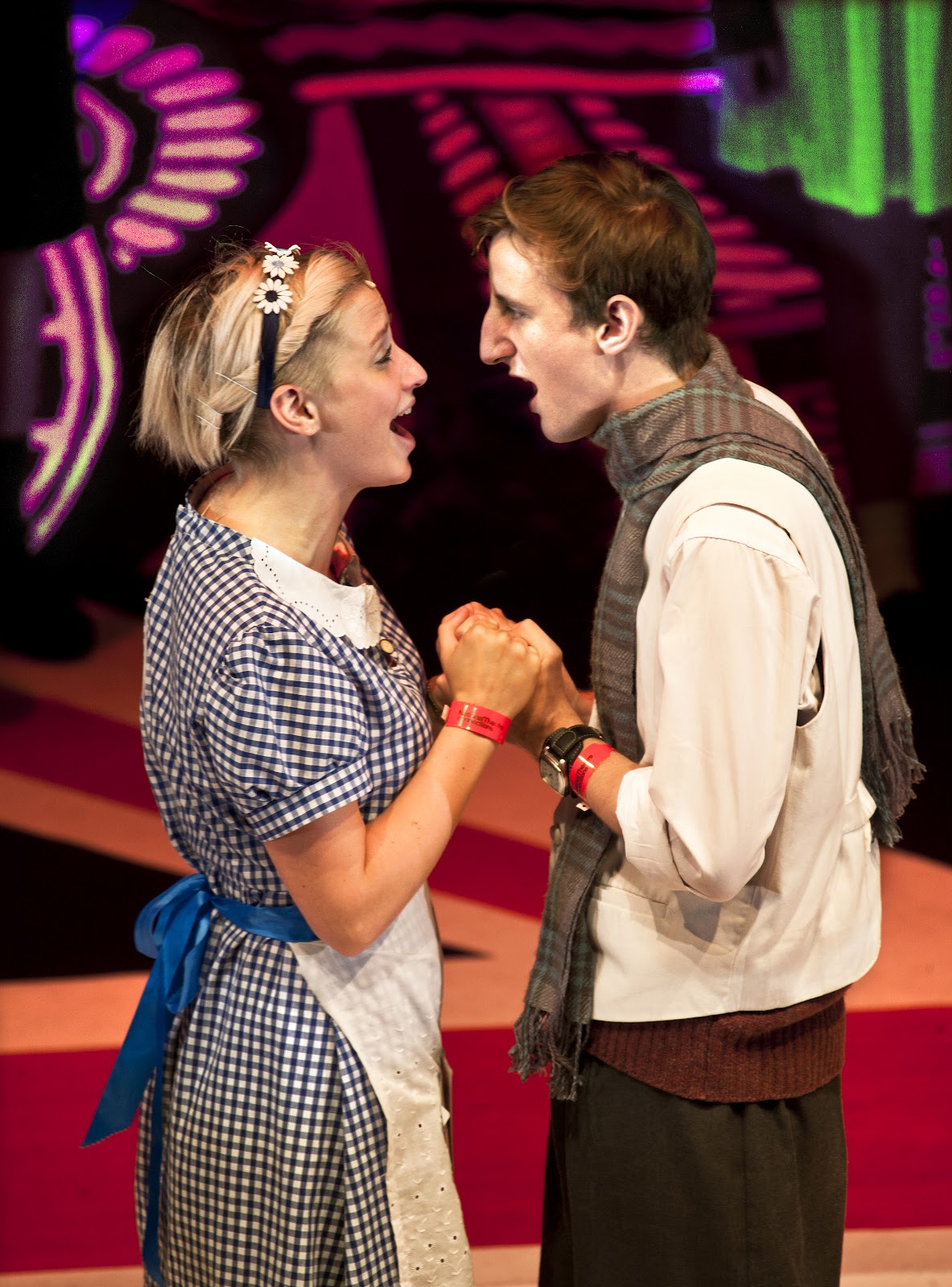
Every teenager has their own tale to tell of their journey from childhood to adolescence. ‘Alice by Heart’, written by Stephen Sater and Duncan Sheik, explores the story of Alice Parsley as she leaves her childhood behind. Set during the war in a London underground station, Alice and her dying friend Alfred fall down the rabbit hole to well-known Wonderland for one last adventure. With Alfred playing the White Rabbit, and Alice her namesake, the adventure is one that turns out to be far from the classic story we have come to love.
Flying High Theatre Company in Alice By Heart, Photo: Simon Annand

Teenagers face many problems while growing up; drugs, peer pressure, changing physical appearance, sexual feelings. Sater and Sheik’s rock-musical addresses these problems in comical ways that highlight problem areas for many in growing up. It seems that for Alice, these problems are best handled in a land where not everything is at it appears, although her confusion seems doubled as the classic tale she remembers by heart changes around her.

The first problem addressed is changing physical appearances, with mock Alice characters taunting her about her figure; “you don’t have the chin for that”. A problem that many teenagers, mostly female, have to face as they lose their innocent figures for new curvaceous frames. We are then introduced to sexualised Caterpillar, who is obviously impressed by the new Alice; “grow yourself such breasts and hips.” The singular Caterpillar character we all know in the original story is replaced by multiple Caterpillars, who all team up to peer-pressure Alice into taking drugs, again another problem that some teenagers may face. Imagine all of the problems you faced, or are facing, as a teenager. In short, the classical tale is changed to reflect these problems, with Alice facing and dealing with them all.
Flying High Theatre Company in Alice By Heart, Photo: Simon Annand

One of the final musical numbers in ‘Alice by Heart’ is a song with the line “isn’t it a trial to try and stay a child?” and this seems to sum up the whole process of leaving childhood behind. Whilst the original Wonderland Alice visited was a magical land, times had changed and the story changed too, leaving Alice wishing for the innocent, simple place she knew before. Through Sater and Sheik’s clever adaptation of a timeless and popular story, we are shown that the journey to and through Wonderland, from childhood to adolescence, is never the simple journey we wish it would be.