Tuesday, 3 July 2012

Day 5 Round Up

PJ Choi, Young Journalist with a round up of Day 5 of Connections at the NT

Prince of Denmark- Michael Lesslie
The last day of the Connections Festival saw two plays which were- in their own ways- re-imaginings of Hamlet and Alice in Wonderland. 

Michael Lesslie’s Prince of Denmark was originally written as a companion to the National Theatre’s production of Hamlet in 2010. Its inclusion in the Connections Festival is extremely apt. The young actors step into their roles and unphased by the big names that will later play their roles in various productions of Hamlet, make them their own with aplomb. Prince of Denmark sees the relationship between a teenage Hamlet, Ophelia and Laertes. Lesslie manages to capture the nuances of Shakespeare’s brooding Hamlet- torn between his duties as a Prince and his own feelings- “Am I a man or a prince?” The strong willed, yet ultimately passive and powerless character of Ophelia is explored further in this play, with Hamlet choosing going to university in Wittenberg over a relationship with her, and characters with minor roles in the original Hamlet are given more prominent roles. The original role of Osric is but a mere few pages in the play but in Prince of Denmark is expanded to a suitably foppish character - true to original form providing well timed comic relief.
Prince of Denmark, Calderdale Theatre School. Photo: Simon Annand
The play is written in iambic pentameter- a nod to the format employed by Shakespeare- but in contemporary English. This combination of Elizabethan and modern in not only the language but also with the costumes remind us of the youthful nature that Lesslie and the Connections festival are aiming to convey. Ophelia’s dress is unmistakeably Elizabethan in design, but in turquoise and pink foil, the colours put a contemporary twist on traditional dress. The boys are in trainers and skinny jeans with brocade jackets and capes. The costumes paying homage to the original Elizabethan drama, but like the concept of the play itself with the idea of a new generation imprinted in the audience’s mind.

The action in the play echoes the events in Shakespeare’s Hamlet. The duel between Hamlet and Laertes is revisited as the climax of the action in Lesslie’s play- with some impressive stage fighting by the young actors. The tensions between the two in this prequel are a suitable additional justification for the tensions that run in Hamlet as the sequel to Prince of Denmark.
Lesslie provides us with subtle allusions throughout Prince of Denmark to make those with a previous knowledge of Hamlet give a knowing chuckle without too many claggy references, but as a standalone piece addresses issues still relevant to the youth of today- going to university, the importance of reputation, family affairs to name a few- which makes Prince of Denmark not only an effective prequel to The Bard’s tragedy, but an extremely worthy participant in the Connections Festival.
 
Alice by Heart- Duncan Sheik and Steven Sater
When asked about their play in the Connection Writers’ Forum, which I was fortunate enough to partake in, Duncan Sheik and Steven Sater were asked about their work and its relevance to the youth today. Sater answers that the story of Alice in is an extended metaphor about drugs and sex. I was excited to see Alice by Heart knowing that Sheik and Sater had both previously written Spring Awakening which I greatly enjoyed- drawing further comparison to Spring Awakening, this play also deals with timeless teenage issues such as sex, drugs and death. Alice by Heart, however, seems to certainly be more explicit about the issues with songs including lyrics such as “Now you’ve found the hole” and “And when we’re high.” When Alice asks if the White Rabbit has “found someone else to give his gloves” and the Cheshire Cat purrs her approval of the combination of words “pleasure” and “puss” the allusions to sex are extremely thinly veiled, as are the references to drugs with the frequent calls to “Mary Ann.”

The sultry bass in the third musical number “Aren’t you getting bigger?” adds to the possible and probable interpretation of the song as a euphemism for sex as well as addressing the main theme of growing up which runs throughout the play. There is something to be said about the effect of Sheik and Sater’s music. Their melodies in minor key are able to shake something within you- “Isn’t it a trial?” addresses growing older and the poignant combination of music and lyrics linger with you long after the end. “Chilling the regrets” is reminiscent of music by Jefferson Airplane creates an almost hallucinatory effect on the listener, and the frequent wordplay emulating the trippy experience which Alice is currently experiencing. It is thrilling that Sheik and Sater are able to send shivers every time I listen to their music. I was extremely impressed with the way in which the young actors were able to fill the theatre with their extraordinary stage presence, a feat that all the actors should be extremely proud of- as Nicholas Hytner stated in the closing of the festival.
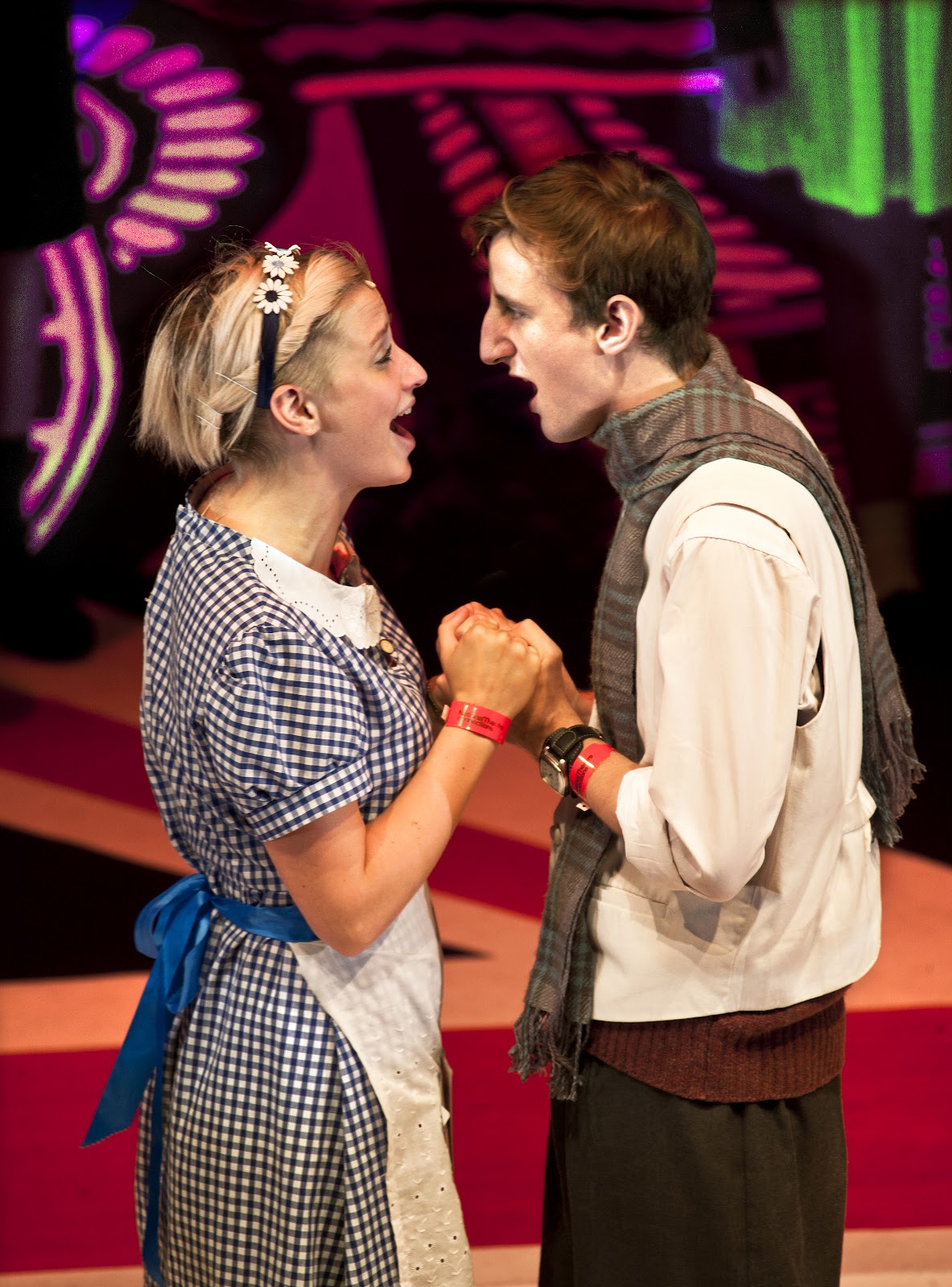
Alice by Heart, Flying High Theatre Company. Photo: Simon Annand

The play, whilst using characters from the Lewis Carroll’s original story, dissects the usual Alice story and rearranges it in such a way that it overthrows the traditional perception. By using meta-literary references to the Carroll’s book, having Alice ‘turn the pages’ and the White Rabbit calling Alice out on omitting the episode where she destroys his house, Sheik and Sater are able to deploy the themes prevalent in the original tale whilst rewriting the story to suit a more teenage driven agenda. The song “We’re sick to death of Aliceness” shows how the story has been turned on its head with the revamped characters now rebelling against the protagonist singing lines such as “stop analysing everything you’ve read.”

The resonating message to be taken away from the play is one about growing up, a message which links all of the plays seen in the past five days-what better way to celebrate a festival promoting youth in theatre than teenage retellings of classic stories? The answer to this question makes Alice by Heart a fitting and fantastic conclusion to the Connections Festival 2012.

The Prince of Denmark

Rosina Sabur, Young Journalist at Day 5 of Connections at the NT

Being ushered into a darkened theatre whilst young actors performed their dress rehearsal, I think I could be forgiven for mistaking these young people for seasoned professionals. The professional way they carried out their rehearsal was impressive, as was their presence on stage.

Watching their interactions with the crew and directors, it would be difficult to distinguish those who worked at the National Theatre full-time from the visitors - the height difference was the only clue! Sitting in on the dress rehearsal was a fascinating experience. As a regular visitor to the National Theatre I have often been left in awe of the seamless productions, so being let ‘behind the scenes’ so to speak, was a real treat. The rehearsals revealed the precision necessary for quality productions - be it the timing of the music, the position of the lighting or the movement of the actors.

The minimalistic staging focused all our attention on the actors’ performances, which were superb. They really got to grips with the anxieties of their teen characters, and astutely interpreted the parental expectations.


Prince of Denmark by Calderdale Theatre School, Photo: Simon Annand

Of course, having a great play to work with helps. Michael Lesslie’s Prince of Denmark, a prequel of sorts to one of Shakespeare’s most renowned tragedies, Hamlet, was excellent. Lesslie’s use of iambic prose created a flow of language which had echoes of the great bard’s own flair and wit. If Shakespeare were writing today, I can well imagine him writing in a similar way, albeit with a slightly more modern vocabulary!

Speaking at the Writers’ Platform, Lesslie explained that Prince of Denmark “came about in a slightly unusual way”. His brief was to create a short play specifically for young people that would act as a companion to the National’s production of Hamlet.  He discussed his desire to avoid patronising the young people he was writing for and the difficulty of creating a sense of development in a play of under an hour.


Prince of Denmark by Calderdale Theatre School, Photo: Simon Annand
Despite the difficulties, Lesslie created a superb play, which Calderdale Theatre School made their own, complete with Yorkshire accents. A production worthy of the National! I’ve already marked a spot in the diary for next year’s Connections…

A Teenage Wonderland

Emily-Louise Duff, Young Journalist at Connections at the NT Day 5

Every teenager has their own tale to tell of their journey from childhood to adolescence. ‘Alice by Heart’, written by Stephen Sater and Duncan Sheik, explores the story of Alice Parsley as she leaves her childhood behind. Set during the war in a London underground station, Alice and her dying friend Alfred fall down the rabbit hole to well-known Wonderland for one last adventure. With Alfred playing the White Rabbit, and Alice her namesake, the adventure is one that turns out to be far from the classic story we have come to love.
Flying High Theatre Company in Alice By Heart, Photo: Simon Annand

Teenagers face many problems while growing up; drugs, peer pressure, changing physical appearance, sexual feelings. Sater and Sheik’s rock-musical addresses these problems in comical ways that highlight problem areas for many in growing up. It seems that for Alice, these problems are best handled in a land where not everything is at it appears, although her confusion seems doubled as the classic tale she remembers by heart changes around her.

The first problem addressed is changing physical appearances, with mock Alice characters taunting her about her figure; “you don’t have the chin for that”. A problem that many teenagers, mostly female, have to face as they lose their innocent figures for new curvaceous frames. We are then introduced to sexualised Caterpillar, who is obviously impressed by the new Alice; “grow yourself such breasts and hips.” The singular Caterpillar character we all know in the original story is replaced by multiple Caterpillars, who all team up to peer-pressure Alice into taking drugs, again another problem that some teenagers may face. Imagine all of the problems you faced, or are facing, as a teenager. In short, the classical tale is changed to reflect these problems, with Alice facing and dealing with them all.
Flying High Theatre Company in Alice By Heart, Photo: Simon Annand

One of the final musical numbers in ‘Alice by Heart’ is a song with the line “isn’t it a trial to try and stay a child?” and this seems to sum up the whole process of leaving childhood behind. Whilst the original Wonderland Alice visited was a magical land, times had changed and the story changed too, leaving Alice wishing for the innocent, simple place she knew before. Through Sater and Sheik’s clever adaptation of a timeless and popular story, we are shown that the journey to and through Wonderland, from childhood to adolescence, is never the simple journey we wish it would be.

Monday, 2 July 2012

Writers vs. Directors


Nada Showman Day 4 of Connections festival (Saturday 23rd June)

I don’t know about everyone else, but in my mind (for some reason) I envisaged a great conflict between the writer and the director – the former offended about how their perfectly crafted, well-thought out piece  has been chopped and changed by the latter whose artistic vision is a polar opposite to theirs. Whilst this may sometimes be the case it certainly isn’t all the time. To be quite truthful, I was a little disappointed – perhaps the journalist in me would have enjoyed such an angle!

Over the course of the day I was fortunate enough to watch two exceptional plays, both very different yet equally as thought provoking – whether for the didactic message presented by Hilary Bell in her play Victim Sidekick Boyfriend Me or for Anders Lustgarden’s politically charged piece Socialism is Great, both were highly successful and it was clear that both were received well by the audience. Yet I was drawn to exploring the relationship between writer and director and seeing how a formed idea on the page can be brought to life and whether the end result is always what the writer had conceived.

As Anders Lustgarten said, “intent [of the play] is always there from the beginning. I always have something to say and have a way to make it come alive.” So what does he suggest when the play in performance is vastly different to the play he had written? He simply had to “chalk it up to experience, but next time have [his] finger on the pulse from the beginning.”

I was interested in whether all writers have had an experience in which their work just wasn’t re-enacted in a way they had thought it would be. For Hilary Bell her play in performance was much different from how she had imagined it; “[the play] was parallel to my vision, the cast made some distinct choices, particularly the use of Greek chorus, which I didn’t intend” 
however, Bell still appreciated the effectiveness of the chorus. A runner for the NT Connections festival who also has written plays has certainly had such an experience as “I am quite precious about [my plays.] I did a writers and directors workshop and I had to give a director my piece, it was actually quite painful to watch as I am one of those writers who have a clear vision and what the director was doing was good, but was completely different to what I had in my mind.”
I had imagined directors having complete control over the interpretation of these plays, but this idea was quickly deflated after talking to Deborah, one of directors who worked with all the directors of these plays in the directors’ workshop, she discussed her deep sense of worry when directing a new piece as she believes it’s her “job to serve the play and the writer.” She also discussed that there is a sense of some conflict as “when you embark on a journey you want to see where the play goes, there may be an instinct to go down a slightly different route, but your ultimate job [as director] is to serve the play.”   

Despite me searching avidly for some inherent sense of conflict between these two parties what I found instead was a sense of mutual understanding, and a real desire to get to the heart of the piece and perform it in a way that is befitting of the brilliant cast members, director and writer. The end result of this ‘conflict’? Two incredible, evocative plays that stay true to the writers’ vision whilst still expressing the creativity of the director and cast members.

Monday, 25 June 2012

Theatre: A Healing Medium

Saira Khan, Young Journalist, Reviews Victim, Sidekick, Boyfriend, Me by Hilary Bell at Day 4 of Connections at the NT

I found myself in a dark space, furnished with white, haphazardly shaped cubes. Around me resonated the voice of a girl frustrated and defiant, followed by chorusing replies and taunts. The atmosphere was both intense and composed. In front, I saw 16 people dressed in black surrounding her.

I then saw a man handing out cups of coffee to lighting and sound engineers, heard the rustling of a chocolate wrapper and the quiet giggles of one of the crew. I had found myself backstage at the National Theatre, witnessing the 7th play of this year’s Connections Festival.

Victim Sidekick Boyfriend Me is a play about a Girl (Amy Weaver) who is responsible for the death or disappearance of a certain Victim (Jenna Blenkinsop). The Girl is let off uncharged and, when the Victim’s Boyfriend (James Martin) takes her into a Christian youth hostel, she is met with unending forgiveness. At first, she takes this for granted but soon their forgiveness becomes intolerable and she longs for atonement or punishment. They sought to reveal her heartlessness in showing that she accepted the easy way out, and they forced her to feel.

Victim, Sidekick, Boyfriend, Me. Photo: Simon Annand
The professionalism, musicianship and acting of the ~17 year olds of Marine Academy Plymouth was astonishing. Even when the guitar fell slightly off key and the dancing was slightly out of time, it only made the whole production more entertaining. The naturalness of some parts of the performance made the audience feel at ease, laughing at the odd quirky disco moves.

The atmosphere backstage was fun, with jokes, friendly prompting, and the vocal coach making the actors use imaginary vacuum cleaners to clean the stage and impersonate Janice from the television series Friends. But it was always clear the actors took their roles and this opportunity very seriously. They had been practising all day and only had time for a quick lunch – whilst being hassled by journalists -- before finding themselves on stage in a prestigious, and sold out, theatre room.
When asked if she found any part of her character difficult to portray, Amy Weaver replied ‘I struggled to put across the journey from a powerful person to a broken one’. However, on stage, that pervious struggle was impossible to discern. She perfectly embodied the character of the Girl, who, as playwright Hilary Bell put it, ‘cracks and becomes a human being’ towards the end of the play. She reveals this was not only the hardest part to act, but to write, too.

Bell’s intent was to highlight the lack of compassion in today’s society and with crime so easy at hand, she shows us what it costs not to own up to our wrongs. The play explores the themes of forgiveness and revenge, but also accountability. Hilary Bell, although a successful playwright in Australia, told that she had never written for young people before, or so many. 

When asked the difference between writing for younger actors as opposed to more experienced ones, she said ‘acting is like a marathon; those who have experience know how to pace themselves’. Nonetheless, she felt the Marine Academy Plymouth were true to the spirit of the play and loved their enthusiasm. She highlighted that there is great responsibility in a Festival such as this, where the vulnerability of young actors must be taken into account. Not only are they being challenged, but they are also being completely submerged into a world of fiction which they may invariably relate to their own lives.

Victim, Sidekick, Boyfriend, Me. Photo: Simon Annand
Connections is not just beneficial for the young actors in boosting their CVs, it is, as Bell put it, a ‘healing medium’ and a way for them to express themselves. But what is interesting is that it is just as beneficial, new, exciting and challenging for the actors, as it is for the playwright, crew and audience. Connections encourages so many people to be involved in the exposure of fresh talent to the world.

Refelctions


Written by Amber Henry

In the wake of Saturday night's productions, the Connections Festival is relatively quiet, starting to prepare for tonight's plays after a Sunday break. Relative, in contrast to the sounds of the last performances, complete with creepy backing tracks, laughter, applause, occasional shrieks (mine), Chinese chanting, and the general excited noise present in and around the Cottesloe, part of the National Theatre, during the last set of performances. 

But now with Saturday's programme past, and with the final day of The Festival tonight, I thought it a good idea to look at where the theatre groups involved in Saturday's production came from, how they got to the Connections Festival, and from their stories how others might be inspired to get involved, or even try again. 

Group 64 and Marine Academy were the stars of Saturday night’s showcase, and both won their place through auditions. The auditions involve over a dozen local groups converging to a local theatre, performing the same play in front of National Theatre directors and writers, who decide on which group will take that play onto the Connections Festival. 

For Marine Academy, their audition was the first time the company performed a full scale production, and up against youth theatres with more experience, they won! When asked how the process was, performing for the first time in front of such a big audience, ‘nerve racking’, ‘exciting’, and also ‘fun’ were the main responses, and backstage before their national theatre performance, the feelings were no different, the cast nervous and enjoying themselves in equal measure – and perhaps ‘hungry’ could be included; the interviews were conducted during their lunch break. The Connections performance was only their second, although hopefully not the last, and a bigger step up from the auditions, performing to an absolutely packed to the brim Cottesloe Theatre. Backstage before the show the actors shared lots of laughs, seemingly fuelled by both nerves and friendship. They attribute being able to perform on a major stage, despite their newcomer status, to being a close, supportive unit; many joined the company together  after meeting in drama class at school in Plymouth.

Group 64 from Putney, London, are closer geographically, but had their own journey to get to the Connections Festival. Last year the company auditioned  but just missed out on the final cut. They were disappointed not to be going to The National Theatre, but were glad they got involved with Connections, describing the audition itself as an amazing experience. The London auditions take place at the Lycra, but all the auditions throughout the country are a unique opportunity for youth companies, no matter their size or experience, to get onto a big stage, get experience, meet other local performers and theatre professionals and make an impression. Hopefully groups will go onto perform at Connections, but theatre companies get those benefits, regardless of the result of the auditions. So despite the disappointment of missing out on a place in 2011, the positive experience of the audition and chance to perform at Connections drove Group 64 to re-audition. They went back to the Lyrca this year, won their auditions, and finally performed at The National Theatre with a sold out show. “Chuffed” to get through, members of the Group describe a similar setting to Marine Academy’s, and speak affectionately of their company as a close knit  group of dedicated aspiring actor creating a the mutually supportive environment which helped the company persevere with their ambitions to perform at The Connections Festival. 

The experiences of both Marine Academy and Group 64 show two great things about getting involved with Connections.

Firstly, its open to all young companies of all experiences, from small drama school classes or bigger youth theatres; everyone has an equal opportunity to perform at the auditions or at The National Theatre, and like Marine Academy proves, those

Additionally, every group that participates in the auditions, whether they go through to the National Theatre or just miss out on a place, benefit from and enjoy the process of the auditions. Group 64 did, so much so that they came back and got a show at the festival!  So it's well worth getting involved, either for the first time or trying again; you never know what could happen or where it could take you!   

Youth Theatre is Great (and so is Socialism)

Aren Goetcherian, Young Journalist, rounds up Day 4 of Connections at the NT

On Saturday we were privileged enough to see two more examples of great writing and great performances. ‘Victim Sidekick Boyfriend Me’, performed by Marine Academy Plymouth, looked at the ability to slip through the cracks after doing something wrong, and the consequences of doing so, while ‘Socialism is Great’, performed by Group 64, from London, looked at the widely varying ideals and realities amongst the different classes of modern day China. Both plays were specially written for the Connections Festival, but, perhaps more importantly, both plays were specifically written to be played by young people.

While the youth of the UK are so often criticised, the Connections Festival aims to celebrate youth theatre, and Saturday’s performances certainly proved testament to the hard work of young people. Hilary Bell (writer of ‘Victim Sidekick Boyfriend Me’) said it was ‘a real privilege’ to be able to work in conjunction with the Connections Festival, and with such promising young performers. Anders Lustgarten (writer of ‘Socialism is Great’) told me how satisfying it was to see young people performing in a professional context. ‘There was no ego, no nonsense’ he told me after the performance. The Connections Festival as a whole, however, certainly shows the enthusiasm of young people, and shows how opportunities like this are essential in encouraging this hard work. Both writers expressed how incredible an opportunity the Festival is, not only for the young people, but also for themselves as writers, neither having written a play exclusively for young people before this. It makes me wish there were already more plays that youth theatre groups could grab and use, and tweak into their own visions.
Socialsim is Great, Photo: Simon Annand
The National Theatre is a far bigger arena than either of these companies has ever experienced, but despite how daunting it may have seemed to perform in such a venue, there was an overwhelming sense of enthusiasm and excitement. Being lucky enough to sit in on the dress rehearsals and vocal warm-up, it was clear that the one common factor between all of the performers was their enjoyment of the experience. The Marine Academy group told me how their closeness as friends brought support as well as fun to the rehearsals, with ‘banter’ being named by the group as one of the most enjoyable things about the Festival (more than evident in their vocal warm-up and their sign language conversation with some members of the public outside the NT’s pop-up see-through rehearsal space sent giggles all round). For some it was the experience of the big city that was just as exciting as the performance. One cast member from Marine Academy Plymouth told me that this was the furthest she’d ever been from home (some three hour train journey away). ‘The tube was less packed than I thought it would be’, another cast member added (they clearly managed to avoid the rush hour – an achievement in itself if you ask me).
Victim, Sidekick, Boyfriend, Me, Photo: Simon Annand

For writers and performers alike, therefore, it seems that the National Theatre’s Connections Festival provides a fantastic opportunity to blow many stereotypes of young people away, and simultaneously breath some new life into the world of theatre. It was refreshing for me to see young people perform with such enthusiasm and professionalism, while never forgetting to enjoy the experience.